
- Two MFDS notices adopt ISO 23675 and ISO 24443. Europe now recommends in vitro testing as the preferred method; the US, Australia and Japan still rely mainly on human testing.
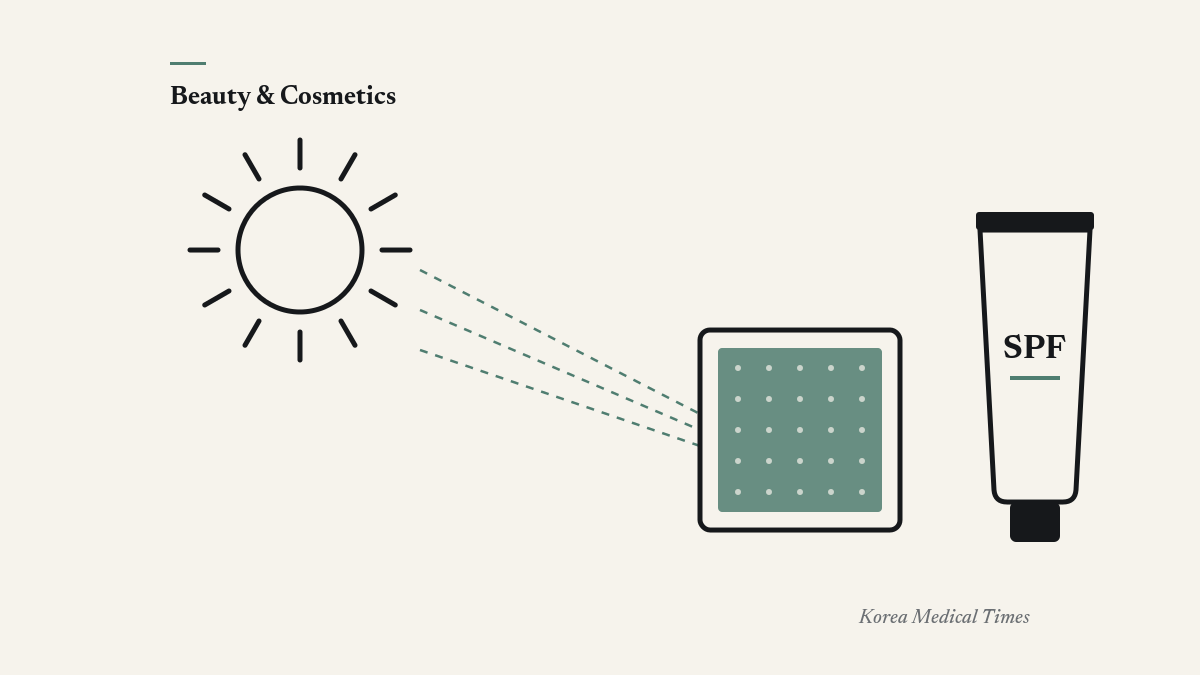
Until now, SPF in Korea has been determined only by human testing, which compares skin reddening after controlled UV exposure. The amended notices add ISO 23675, the International Organization for Standardization's in vitro method, for SPF and ISO 24443 for PA. Existing human-test methods, including ISO 24444 and ISO 24442, remain valid. When the draft was pre-announced in August, the MFDS said a human SPF test takes about a month and costs around 6 million won, whereas an in vitro test takes about two days and costs around 3.5 million won.
The rules for water-resistant SPF were not changed. ISO 23675 itself is limited to emulsions and single-phase alcoholic formulations. It excludes powders, compact powders, sticks and water-resistance testing.
The scope for waiving efficacy data is narrowed. Under the current rules, a product is exempt from submitting efficacy data if its active ingredients, directions for use and formulation match a product already reviewed. Under the amendment, every ingredient must match in type, specification and quantity. The only permitted changes are to fragrances, preservatives and colourants below 1% (except in water-resistant products). Even with the same active ingredients, a product with changed excipients may not qualify for the exemption.
The substantiation notice adds new evidence requirements for claims of SPF, water-resistant and very water-resistant SPF, and PA. Such claims must be backed by human or in vitro test data obtained during functional-cosmetic review or reporting. When the draft was pre-announced, the MFDS explained that the change would set out substantiation standards that had previously been missing, so that SPF and related claims could be labelled or advertised only when proven by testing. Under the supplementary provisions, both notices apply to review requests and product reports submitted on or after the effective date. The way SPF and PA appear on packaging is unchanged.
How other regulators approach it
European Union: ISO 23675, developed under the lead of the industry body Cosmetics Europe, was published in December 2024. In a revised recommendation in June 2025, Cosmetics Europe advised its members to phase in ISO 23675 and the hybrid diffuse reflectance spectroscopy method (HDRS, ISO 23698) as preferred alternatives to human testing (ISO 24444), while stating that existing SPF values from human tests remain valid. In September this year, the European Commission reported that in vitro testing of 74 products selected by market surveillance authorities in 11 countries correlated closely with human testing, and urged manufacturers to prioritise tests that cause no harm to people.
United States: Sunscreens are regulated as over-the-counter (OTC) drugs. The FDA's OTC Monograph M020 specifies human testing for SPF, while in vitro testing is used to determine broad-spectrum protection.
Australia: Therapeutic sunscreens must pass testing to AS/NZS 2604, based on ISO 24444, before listing. The Therapeutic Goods Administration (TGA) says sponsors may hold ISO 23675 and ISO 23698 data as supplementary evidence for review, and in October it announced reforms that include stronger testing requirements.
Japan: The voluntary SPF and PA standards published by the Japan Cosmetic Industry Association (JCIA) are based on ISO 24444 and ISO 24442. As of November 15, they do not include ISO 23675.
Korea: The new notice names ISO 23675 as the in vitro SPF method. HDRS (ISO 23698) is not on its list of measurement methods.
What shoppers should check
SPF indicates protection against UVB (290–320 nm); PA indicates protection against UVA (320–400 nm). It is best to check both.
The SPF number on a Korean label is a whole number set up to 20% below the measured average. Values of 50 or more are shown as "SPF50+".
PA is shown in four grades: PA+ (low), PA++ (moderate), PA+++ (high) and PA++++ (very high).
For swimming or sweaty outdoor activity, look for a "water-resistant" or "very water-resistant" label. ISO 23675 cannot be used to assess water resistance.
The notices do not require packaging to state which test method was used, so products tested on people and products tested in vitro cannot be told apart by their labels. Both follow the same labelling standards.
In vitro data can be used only for products newly reviewed on or after November 11, 2027.
The European Commission advises applying sunscreen generously and evenly before sun exposure, reapplying it, and using it alongside other protection such as shade and clothing.
This article is based on the MFDS notices and on public documents from regulators in other countries and from the International Organization for Standardization.
Sources
· MFDS, amendment to the Regulation on the Review of Functional Cosmetics (Notice No. 2026-75), posted Nov 11, 2026
· Korea Cosmetic Industry Association, MFDS notice on the functional-cosmetics review amendment (full text attached), Nov 2026
· Korea Cosmetic Industry Association, MFDS Notice No. 2026-76 on labelling and advertising substantiation (full text attached), Nov 12, 2026
· MFDS press release on introducing in vitro sunscreen testing, Aug 19, 2026
· Korea.kr policy briefing (MFDS release), Aug 19, 2026
· MFDS pre-announcement of the draft amendment, Aug 18, 2026
· ISO 23675:2024, In vitro determination of SPF
· Cosmetics Europe, Recommendation No. 26 (revised June 2025)
· European Commission DG GROW, "EU moves to more ethical sunscreen testing," Sep 15, 2026
· US FDA, OTC Monograph M020: Sunscreen Drug Products
· TGA, acceptance of additional SPF testing information
· TGA, "TGA strengthening sunscreen regulation to improve confidence in SPF claims," Oct 27, 2026
· JCIA, voluntary standards and guidelines on UV protection (Japanese)
· Korean original: Korea Medical Times, Nov 15, 2026
This article is for information only and is not medical advice.
ⓒ Korea Medical Times & koreamedicaltimes.com 무단전재-재배포금지
BEST 뉴스
-
Korea to Accept Non-Human SPF Testing for Sunscreens From November 2027, While Tightening Exemptions and Claim Substantiation
Graphic: Korea Medical Times Korea's Ministry of Food and Drug Safety (MFDS) has amended two regulatory notices so that sun protection factor (SPF) and protection grade of UVA (PA) values measured in vitro, on polymethyl methacrylate (PMMA) plates rather than human skin... -
MFDS Issues Safety Letter on Optic Neuropathy Risk With GLP-1 Drugs for Obesity and Diabetes
Graphic: Korea Medical Times Korea's Ministry of Food and Drug Safety (MFDS) said on November 11 that it had distributed a drug safety letter to healthcare professionals and patients after overseas data suggested that glucagon-like peptide-1 (GLP-1) receptor agonists, u... -

Korea's First Formal Evaluation of 'Pre-Entry' Medical AI: What Is Being Tested, and Why Passing Does Not Guarantee Insurance Coverage
Graphic: Korea Medical Times Korea's National Evidence-based Healthcare Collaborating Agency (NECA) is conducting its first formal evaluation of the safety and effectiveness of medical artificial intelligence (AI) technologies that have been used as non-reimbursed ser... -

Planning Medical Care in Korea: How International Patients Can Check Registration, Visas, Interpreters and Their Rights
Graphic: Korea Medical Times Korea has a dedicated legal framework for international patients. The Act on Support for Overseas Expansion of Medical Services and Attraction of International Patients (current text in force from 12 May 2026) sets out who may arrange care... -

US, Mexico and Bolivia lose measles elimination status; travellers urged to confirm MMR vaccination before departure
Graphic: Korea Medical Times Quotations originally in Korean have been translated by KMT. PAHO quotations are from PAHO's English-language release.The Pan American Health Organization (PAHO) announced on Nov 17 (local time) that endemic measles transmission has been r... -

Korea's Digital Healthcare Act draws criticism over consent-free use of pseudonymised medical data; Health Ministry says bill follows the PIPA framework
Graphic: Korea Medical Times Quotations originally in Korean have been translated by KMT. EHDS wording is quoted from the official English text of Regulation (EU) 2025/327. The so-called Digital Healthcare Act, pending before the National Assembly Health and Welfare ...
전체댓글 0
NEWS TOP 5
-
1
Korea to Accept Non-Human SPF Testing for Sunscreens From November 2027, While Tightening Exemptions and Claim Substantiation
-
2
MFDS Issues Safety Letter on Optic Neuropathy Risk With GLP-1 Drugs for Obesity and Diabetes
-
3
Korea's First Formal Evaluation of 'Pre-Entry' Medical AI: What Is Being Tested, and Why Passing Does Not Guarantee Insurance Coverage
-
4
Planning Medical Care in Korea: How International Patients Can Check Registration, Visas, Interpreters and Their Rights
-
5
US, Mexico and Bolivia lose measles elimination status; travellers urged to confirm MMR vaccination before departure